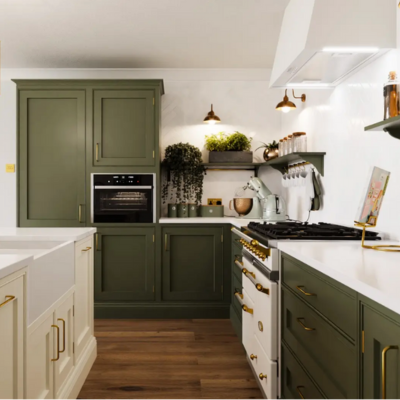
Dream kitchens typically start with a sledgehammer and the removal of the old one. But as we become more conscious of how we update our homes, a crucial question is emerging: do we really need to bin the old and bring in more new?
Every year across the UK, thousands of high-quality kitchens are sent straight to landfill because homeowners want a change of layout or a luxury showroom needs to update its seasonal displays. The result is a huge amount of waste of craftsmanship, raw materials, and embodied carbon.
Enter the circular economy.
The truth is, a premium kitchen’s lifespan is rarely tied to a single home. A well-built, beautifully designed kitchen can, and absolutely should, have more than one life. By shifting our mindset from “dispose and replace” to “rehome and reuse”, we can unlock a new way to approach interior design.
Whether you’re an eco-conscious buyer looking to secure a luxury, high-end space for a fraction of the retail price, or a homeowner hoping to fund your upcoming renovation by selling your current cabinets, the secondary market is changing the game. Here’s why rethinking the traditional kitchen renovation cycle isn’t just the ultimate win for the planet; it’s the smartest financial move you can make for your home.
What is the traditional kitchen renovation cycle?
For decades, the standard kitchen renovation has followed a fairly predictable pattern, something like this:
- Remove the existing kitchen, regardless of how much useful life it may still have left.
- Dispose of cabinetry, worktops and fittings, often because there is no onward plan for them.
- Order a completely new kitchen, including newly manufactured units and materials.
- Install the replacement, starting the cycle again until the next renovation.
The problem is that this approach focuses almost entirely on what’s next, rather than asking what could happen to the kitchen they already have.
Cabinets can be dismantled simply because an extension has changed the room's dimensions. Stone worktops can be removed because a new colour scheme is planned. High-end appliances may be replaced because the incoming kitchen is being designed as a complete package.
Without a buyer lined up or a proper dismantling plan, materials that took lots of energy and resources to manufacture end up being thrown away long before they’ve reached the end of their functional life.
A circular approach changes the question from "How do we get rid of this kitchen?” to “Who could use it next?”
Why are kitchens replaced before the end of their usual life?
Unlike a boiler that stops working or a roof that starts leaking, kitchens are rarely replaced because every component has suddenly failed.
More often, it's change.
Perhaps a family is knocking two rooms together to create an open-plan kitchen space. New homeowners are after a different look.
Then there’s the influence of interior trends. Colours, handles, worktops, and door styles move in and out of fashion, so a kitchen can look dated long before the cabinets are anywhere near worn out.
That disconnect between useful life and first-owner life is exactly where the second-hand kitchen market comes in. A kitchen may have done its job in one property without being anywhere close to finished.
How long can a quality kitchen actually last?
No single expiry date is stamped on a kitchen.
Its lifespan depends on everything from the quality of the original cabinetry and hardware to how heavily it’s been used, how well it’s been maintained and whether individual parts can be repaired or replaced.
A well-made kitchen should remain functional for decades. Solid cabinet carcasses, good-quality hinges, sturdy drawer runners and durable worktops don’t automatically become unusable because the room around them is being redesigned.
In many cases, the visible parts of a kitchen are also the easiest to refresh. Handles can be changed, doors repainted or refinished, damaged hinges can be replaced, and new worktops can completely give you a new look.
This is why age alone tells you little about whether a kitchen deserves another life.
Condition is far more important.
A ten-year-old premium kitchen that has been properly looked after could offer more usable life than a newer kitchen built from lower-quality materials. Likewise, an ex-display kitchen may have been assembled for years but has little wear from everyday cooking and home life.
What does a second-life kitchen actually mean?
A second-life kitchen is what it sounds like: a kitchen that has finished serving one space and is ready to begin again somewhere else.
Rather than dismantling cabinets ready for the skip, they’re carefully removed with reuse in mind. The kitchen can be transported to its new owner, where the cabinetry, appliances and other components are installed in a different home.
Crucially, it doesn’t mean you have to recreate the original room like-for-like.
Kitchen cabinets are modular, so an experienced fitter can often rearrange, reposition, and adapt the overall look to work differently.
The same idea applies to ex-display kitchens. A showroom might remove a display to make space for a new range, but that doesn’t mean the kitchen is outdated, damaged, or unusable. In fact, it might give someone the chance to buy premium designs that would cost a whole lot more if ordered from new.
This is where the renovation cycle begins to look less like a straight line and more like a loop.
One homeowner removes a kitchen. Another gives it a new setting. Existing materials remain in circulation, valuable craftsmanship is preserved, and fewer perfectly usable products are treated as waste.
A second-life kitchen is not simply an “old kitchen”. It’s an existing resource waiting for its next home.
The environmental impact of rethinking renovation
The environmental case for reusing kitchens is simple: the longer we keep well-made products in circulation, the less pressure there is to manufacture replacements from scratch.
A kitchen contains far more than just a row of cupboards. There are timber products, metals, glass, stone, plastics, hardware, appliances and finishes, all of which have used energy and are made up of raw materials that need to be produced, processed and transported.
When you remove and discard a kitchen, all that embodied carbon goes with it.
Rehoming turns that model on its head.
Instead of treating renovation as removal and replacement, it creates an opportunity to preserve what already exists and extend its useful life.
From a linear model to a circular one
| Traditional renovation | Circular renovation |
| Manufacture new materials |
Make use of existing materials |
| Install in one home |
Install and potentially reuse elsewhere |
| Remove when tastes or layouts change |
Assess what can be rehomed |
| Dispose of usable components |
Keep cabinets, worktops, and appliances in circulation |
| Start from scratch again |
Build on what already exists |
It matters because reducing waste is only part of the picture.
The bigger opportunity is to reduce the need for new products in the first place. What’s more, unlike some sustainable home improvements, it doesn’t mean compromising on design. A beautifully made kitchen can still be stylish, luxurious, and perfectly suited to a new space, while carrying far less of the “new at all costs” mentality that has traditionally shaped renovation.
Why rehoming kitchens makes sense financially
Sustainability may be one of the biggest reasons to rethink the renovation cycle, but there is another major incentive: cost.
Premium kitchens are a significant investment when purchased new. Buying a second-life kitchen can change that equation completely.
Rather than paying separately for every premium upgrade, buyers will often find that these features are already included.
This can mean access to:
- High-quality cabinetry
- Quartz, granite or other premium worktops
- Integrated appliances
- Kitchen islands
- Larder cupboards
- Deep pan drawers
- Internal organisers and pull-outs
- Premium sinks and taps
For buyers, this can make higher-end kitchen brands and specifications more achievable without paying the original retail price.
But the financial benefits aren’t limited to the person buying.
A homeowner planning a new kitchen could be sitting on an asset they just assumed was ready to be skipped and tipped.
Selling your current kitchen with Rehome
If your existing kitchen is still in good condition, selling it before your renovation begins lets you recover some of its remaining value.
This creates a very different cycle:
Sell the existing kitchen → put the proceeds towards the renovation → allow another homeowner to reuse it
Selling through Rehome allows you to think about the kitchen as part of the renovation plan from the beginning, which has several benefits:
- Buyers can see what they’re purchasing: Take pictures while it’s still installed so it’s easy to see the layout, finish, proportions and overall conditions
- The kitchen is removed with reuse in mind: Dismantling a kitchen focuses on preserving it. Careful removal helps protect key parts of the kitchen and gives it the best chance of being reinstalled elsewhere.
- You give the kitchen a chance to retain its value: Selling your kitchen lets you recognise any remaining value rather than losing it with disposal.
Designing for the future
The biggest chance the circular kitchen economy can create is not what we buy today, but how we think about renovation tomorrow.
What if we stopped assuming every kitchen had one owner, one room and one life?
Instead, we could start choosing kitchens with longevity in mind: good-quality cabinets, durable hardware, repairable components and layouts that can be adapted.
It doesn’t mean keeping the same kitchen forever.
Homes change. Families change. Tastes change. Sometimes a new layout really is the right decision.
The difference is what happens next.
When we see a kitchen as an asset rather than disposable fixtures, the possibilities widen, and that is what a circular renovation cycle looks like.
The dream kitchen no longer has to begin with a sledgehammer and end with a skip. It can start with asking what already exists, what can be reused and what deserves another life.
Whether you are looking for a premium kitchen at a lower price or planning to replace your current one, Rehome helps keep beautifully made kitchens moving from one home to the next.
Browse approved used and ex-display kitchens with Rehome, or sell your current kitchen and give it a chance to become someone else’s dream space.