

We’re all too familiar with the environmental cost of fast fashion, but another problem has quietly taken over our homes: fast interiors.
Driven by fleeting micro-trends and the allure of flat-pack convenience, the modern kitchen renovation cycle has drastically shortened. What was once considered a thirty-year, multi-generational investment is now routinely ripped out and sent to a landfill after just five to ten years, discarded simply because a cabinet colour has had its time or the budget laminate began to peel.
This relentless rip-out culture carries a big environmental footprint, filling skips across the UK with perfectly functional cabinets and driving up embodied carbon through the constant, energy-intensive manufacturing of new materials.
But hopefully the tide is turning, and homeowners are rethinking how they renovate.
Circular design is coming to the forefront. Consumers are becoming aware that true luxury isn’t found in disposable pieces, but in solid design and build that will last a lifetime.
Instead of buying new and cheap, forward-thinking renovators are turning to the second-hand market. By embracing preloved and ex-display kitchens, we can rescue premium, bespoke craftsmanship from the scrap heap and give it a second life. This shift in mindset proves that the most beautiful, sustainable, and trend-forward kitchen you can install is often the one that has already been built.
The hidden footprint of the modern rip-out
When we talk about sustainable kitchens, attention tends to land on the obvious things: energy-efficient appliances, responsibly sourced timber, perhaps a recycling bin neatly integrated into the island.
But arguably the biggest environmental decision happens much earlier: do we really need to manufacture another kitchen at all?
National waste statistics don’t neatly separate kitchen cabinetry from other furniture, but the wider picture is difficult to ignore. Government figures show that an estimated 861,000 tonnes of furniture, mattresses, carpets and underlay entered household and commercial residual waste in England in 2017. WRAP also estimates that around 22 million items of furniture are discarded across the UK every year, and around 20% of discarded home furniture could potentially be reused.
Kitchen renovations add their own substantial material load. Rehome estimates that a conventional kitchen overhaul can generate around one to two tonnes of material waste, once cabinetry, worktops, fittings, fixtures and packaging are taken into account.
And disposal is only part of the story.
The carbon you can’t see
Before a new kitchen arrives at your front door, it’s already accumulated an environmental footprint.
This is known as embodied carbon: the emissions associated with extracting raw materials, manufacturing products, transporting them, installing them, maintaining them and eventually dealing with them at the end of their lives. The UK Green Building Council estimates that embodied carbon accounts for around 20% of the UK built environment’s emissions.
Think about what goes into one kitchen. Timber has to be grown, harvested and processed. Sheet materials require manufacturing and adhesives. Metals are extracted, refined and formed into hinges, runners, sinks and appliances. Stone has to be quarried or engineered, cut, polished and transported. Then every cabinet, worktop and component has to make it through the supply chain to your home.
The scale of the wider furniture industry helps put that impact into perspective. Defra estimates that UK consumption of furniture, furnishings and carpets was responsible for 8.7 million tonnes of CO₂e in 2019, equivalent to almost 1.5% of the UK’s consumption-based carbon footprint.
So when a sound kitchen is replaced purely because its colour has slipped out of fashion, we aren’t simply throwing away cabinets. We’re throwing away much of the material, energy and craftsmanship already invested in making them.
And if the replacement is poorly made and needs replacing again a few years down the line, the cycle begins all over again.
What does a kitchen built for longevity actually look like?
Longevity doesn’t mean designing a kitchen so cautiously that nobody could possibly dislike it.
It means getting the bones right.
A truly enduring kitchen should be able to survive changes in taste, changes in family life, and ideally, changes in ownership. Instead of asking what will look fashionable next year, the better question is, what will still be worth keeping in fifteen years?
Start with cabinets that can evolve
Good cabinetry gives you options.
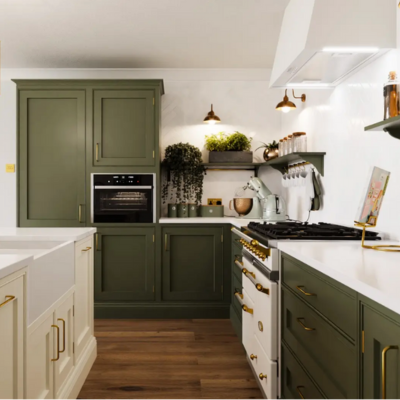
Classic in-frame construction, timber doors and well-made Shaker cabinetry have remained popular for a reason. They don’t rely heavily on one particular moment in design history, and painted finishes can often be refreshed years later.
A turned blue door can become warm white. Brass handles can be replaced with nickel. Walls can change colour. An island can be repainted.
The entire kitchen doesn’t have to go with them.
The ability to repair, repaint and adapt is important because circularity isn’t simply about recycling materials at the end of their life. The Ellen MacArthur Foundation places reuse, maintenance, repair and refurbishment ahead of recycling as ways of preserving the value already invested in a product. Keeping the product whole for longer retains more of its embedded materials, energy and labour.
Look beyond the door fronts
Some of the least glamorous kitchen components are among the most important.
Good hinges and drawer runners can make the difference between cabinetry that becomes frustrating after a few years and furniture that continues working smoothly for decades.
Take Blum as one example. The hardware manufacturer says its hinges are tested through 200,000 opening and closing cycles, while its drawer and runner systems undergo extensive movement and load testing. That isn’t a guarantee that every piece of hardware will last forever, but it shows the engineering that can sit behind premium cabinets.
The same principle applies to worktops. Stone, timber and other quality surfaces can often survive multiple decorative changes around them. In Houzz’s 2025 UK Kitchen Trends study, 44% of homeowners said durability influenced their choice of worktop, compared with just 24% who cited cost.
Perhaps we’re already beginning to value how long something lasts as much as how it looks on installation day.
Keep the expensive bits timeless
There is nothing wrong with trends. Interiors would be fairly uninspiring without them.
The trick is knowing where to use them.
Let a beautifully proportioned kitchen form the backdrop. Then experiment with wall colours, pendant lights, stools, artwork, blinds, ceramics and accessories.
These are the elements that can change as your taste changes.
Replacing a lampshade because chrome has come back into fashion is one thing. Replacing twenty cabinets, a granite worktop and a bank of integrated appliances is quite another.
The preloved revolution
This brings us to perhaps the most interesting development in sustainable kitchen design: recognising that new doesn’t automatically mean better.
For years, “second-hand kitchen” conjured up images of tired cabinets stacked in somebody’s garage.
The reality can be remarkably different.
An ex-display kitchen may never have cooked a single meal. It could have spent its life in a premium showroom, decked out with stone surfaces, high-end appliances, internal organisers, solid drawer boxes and hardware engineered for heavy everyday use.
Approved-used kitchens can be equally impressive. Bespoke cabinetry from homes undergoing extensions or redesigns may still have decades of usable life left. Just because the previous owner no longer needs it doesn’t make that craftsmanship worthless.
Circularity means keeping the whole kitchen valuable
The circular economy is sometimes reduced to recycling, but recycling should be much further down the line.
If a complete cabinet is reused, there is little sense in breaking it into constituent materials first. Recycling preserves material. Reuse preserves the material and the manufacturing, design and build that turned it into something valuable.
That’s exactly why the Ellen MacArthur Foundation describes keeping products intact through reuse as one of the highest-value circular strategies.
At Rehome, we see the impact of that principle every day.
According to our sustainability data, each kitchen rehome saves an average of around 3,500kg or carbon by keeping an existing kitchen in circulation rather than treating it as waste and replacing it entirely with newly manufactured products.
Multiply that across hundreds, then thousands of renovations, and a simple purchasing decision becomes something much more significant.
Better quality can cost less when somebody else bought it first
Longevity also brings up an interesting financial argument.
A £40,000 kitchen and a £10,000 kitchen aren’t necessarily four times different in aesthetic appeal. Much of the difference can be hidden in the construction: cabinet materials, joinery, drawer boxes, hinges, specialist finishes, stonework, bespoke sizing and premium appliances.
These are the things that make a kitchen worth keeping.
The second-hand market changes the economics. Rehome’s marketplace offers approved-used and ex-display kitchens at up to 80% below high street prices, meaning buyers can potentially prioritise a higher original specification without paying its original retail cost.
We’ve seen bespoke and premium kitchens originally costing tens of thousands of points become accessible at a fraction of that price.
Instead of asking: “What’s the best new kitchen I can afford?”, the more interesting question becomes:
“What’s the best kitchen that already exists within my budget?”
That is a very different way to renovate.
Design for the next life, not just the first one
Kitchens aren’t sofas. You can’t simply carry one through the front door and put it down in a different room. But fitted doesn’t mean it’s fixed forever.
Individual cabinets can be rearranged. Straight runs can be separated. Islands can move independently from wall units. A surplus cabinet can become part of a utility room. New end panels or filler pieces can help an existing run meet a different wall.
Worktops may sometimes need alteration or replacement, especially when cut-outs and dimensions don’t translate, but the cabinets underneath can still have enormous value.
A good kitchen fitter can assess what can be retained, altered and supplemented instead of assuming everything must arrive as one brand-new package.
And manufacturers can play their part, too. Standardised components, removable fittings, replaceable doors and serviceable hardware all make it easier for kitchens to evolve rather than expire.
Future-proofing should be part of kitchen design
There are signs that homeowners are already thinking further ahead.
The 2025 Houzz & Home Renovation Trends Study found that 61% of renovating UK homeowners planned to remain in their property for at least another 11 years. Meanwhile Houzz’s Kitchen Trends Study found that 55% of renovating homeowners were addressing current or future special needs when planning their new kitchen.
That longer-term thinking changes what good design means.
Maybe today’s breakfast cupboard becomes tomorrow’s accessible storage. Perhaps an island gets repositioned as the family changes. Maybe cabinets are repainted rather than ripped out, or an existing kitchen is sold when the room is changed.
The kitchen stops being a static product with a beginning and end. It becomes something that can change with time.
The next big kitchen trend might be refusing to chase one
Each year brings another colour, finish or must-have feature.
We’ve had industry. Japandi. Forest green. Navy. Handleless. Brass. Chrome. Marble-effect quartz. Statement stone.
And there will always be something new around the corner.
But perhaps the most progressive kitchen isn’t the one that captures a particular year perfectly.
Perhaps it’s the one where, ten or twenty years from now, somebody still looks at the cabinets and things: that’s far too good to throw away.
Longevity turns sustainability from something you add to a kitchen into something embedded in the way you choose it. Buy better, maintain it, adapt it, repaint it, repair it. And when it no longer works for your home, allow somebody else to get use from it.
Ultimately, the most sustainable kitchen is often the one that already exists, and the next best thing is one that’s made well enough to have a second, third and even fourth life.
At Rehome, that’s exactly what we’re working towards: keeping exceptional kitchens and interiors in circulation for longer.
Explore our curated collection of approved-used and ex-display kitchens, discover premium craftsmanship for up to 80% less than the high-street prices, and find a kitchen designed not just for its first home, but a much longer life.


